
May 04 , 2020. 4 hours ago – 09:55 KYODO NEWS
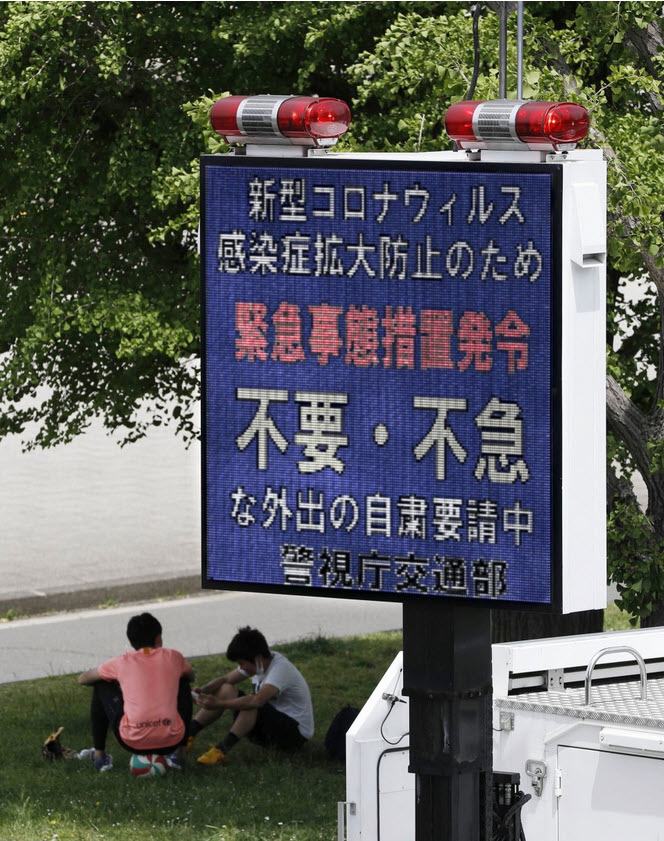
TOKYO – Prime Minister Shinzo Abe will formally decide on a roughly one-month extension to the nationwide state of emergency on Monday to help contain the spread of the coronavirus despite incipient signs of a downtrend in new cases.
The extension beyond Wednesday — the last day of Japan’s Golden Week holiday — to May 31 comes as the medical system has been stretched thin and economic activity depressed due to stay-at-home and business closure requests under the emergency declaration.
Abe laid the groundwork for the extension last week, saying a return to normalcy would not come soon.
A government panel of medical experts recommended Friday that the emergency steps should be kept in place for a while to prevent a surge in new COVID-19 infections that would put an additional strain on hospitals.
As the number of reported cases differs from place to place, the government is expected to ease its stay-at-home requests and allow some economic activity to resume in prefectures where the infection situation is not designated as requiring “special caution.”
The reopening of parks, libraries and museums, meanwhile, will likely be permitted across the country on condition that preventive steps against the virus are taken.
An advisory panel of medical experts will determine whether the extension as envisaged by the government is appropriate before Abe makes his final decision in the afternoon. The premier is scheduled to meet the press at 6 p.m.
Abe declared a monthlong state of emergency on April 7 for seven prefectures covering urban areas including Tokyo, Osaka and Fukuoka. He expanded it to the entire nation on April 16 to pre-empt an expected increase in travel during the roughly weeklong holiday period when many Japanese normally visit their hometowns or go on trips.
To mitigate the damage done to households, he timed the announcement with a pledge to provide each of Japan’s some 126 million people with 100,000 yen ($930) to help ride out the emergency situation.
Currently, the seven prefectures first targeted for the state of emergency are among 13 prefectures designated by the government as needing special caution.
Japan has confirmed over 15,000 coronavirus cases with about 550 deaths.
The government has been calling for a cut of as much as 80 percent in person-to-person contact and a 70 percent reduction in commuting. Crowds and the movement of people have decreased but hitting the targets has proven difficult, according to recent data.
Grocery shopping, hospital visits, as well as jogging and going for walks have been allowed under the state of emergency, which was declared based on a revised law enacted in March.
The law allows a state of emergency to be announced when it is feared the country’s capacity to provide medical care will reach its limit unless measures are taken.
The declaration gives prefectural governors the authority to expropriate private land and buildings to provide medical care.
They can also requisition medical supplies and food from companies that refuse to sell them and punish those that hoard or do not comply.
But stay-at-home and business suspension requests are not mandatory and there are no legal penalties for noncompliance with them.
Still, prefectural governors have urged Abe to extend the emergency declaration, even though its limits have become clear.
Some governors recently released the names of pachinko parlors that defied their closure requests.
CR: KYODO NEWS
 apecthai.com