
APR 09 ,2020. 8 minutes ago – 21:21 KYODO NEWS
WASHINGTON –
The International Monetary Fund said Thursday that it expects the coronavirus pandemic to bring about the worst economic fallout since the Great Depression while urging governments around the world to prioritize containment and healthcare measures before shifting their focus to the economy.
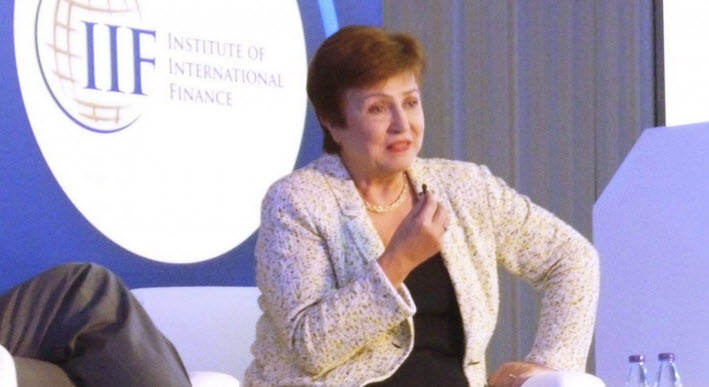
“It is already clear…that global growth will turn sharply negative in 2020,” IMF Managing Director Kristalina Georgieva said ahead of the annual spring meetings of the IMF and the World Bank, as well the release of the World Economic Outlook report next week.
The meetings have been switched to virtual format instead of in-person gatherings due to the coronavirus outbreak, which has killed more than 89,000 people. The global health crisis has brought the world economy to a near standstill as businesses shutter, and people are confined to their homes to avoid further spread of the highly contagious disease.
If the world economy shrinks this year, it would be the first time since 2009, during the peak of the global financial crisis following the collapse of Lehman Brothers the previous year. In 2009, the global economy contracted by 0.1 percent, according to IMF data.
The Great Depression was the worst financial and economic disaster of the 20th century, believed to have been triggered by the 1929 crash of Wall Street. It lasted for around 10 years.
Georgieva said she believes a “partial recovery” of the global economy is possible if the pandemic fades in the second half of 2020, allowing a gradual lifting of containment measures and reopening of the economy.
“But again, I stress there is tremendous uncertainty around the outlook — it could get worse depending on many variable factors, including the duration of the pandemic. And crucially, everything depends on the policy actions we take now,” she said.
As an example of the bleak outlook, the IMF expects that over 170 of its 189 member countries will experience negative per capita income growth in 2020. That stands in stark contrast to three months ago when over 160 countries were expected to record positive income growth.
Retail, hospitality, transport and tourism sectors, in particular, have been hit by the containment measures, while external financing needs for emerging market and developing countries are expected to reach into the trillions of dollars, of which they will only be able to cover a portion on their own, she said.
Georgieva said some encouraging signs are that countries around the world have already taken fiscal actions amounting to about $8 trillion, as well as massive monetary easing measures.
But she still called for the importance of “large, timely, targeted fiscal and financial sector measures” to shield affected people and companies, such as through tax deferrals, wage subsidies and the extension of unemployment insurance.
She also suggested that countries should not rush to ease necessary containment measures for fear of seeing further damage to their economies.
“Some say there is a trade-off between saving lives and saving livelihoods. I say it is a false dilemma. Given this is a pandemic crisis, defeating the virus and defending people’s health are necessary for economic recovery,” she said.
CR: KYODO NEWS
 apecthai.com