
Mar 11 , 2020. 4 hours ago – 07:16 – KYODO NEWS
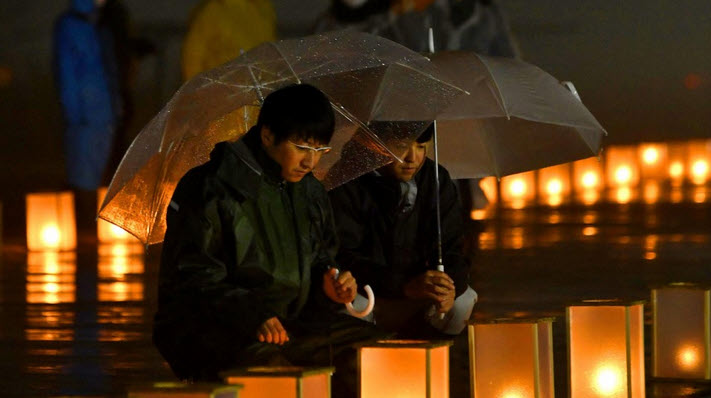
TOKYO – Japan marked the ninth anniversary Wednesday of the massive earthquake and tsunami in its northeastern region that left more than 15,000 people dead, but health fears over the spread of the new coronavirus caused a number of events to be canceled or scaled down.
A state-sponsored memorial ceremony that had been held every year in Tokyo since 2012 was canceled for the first time, with Prime Minister Shinzo Abe saying he will observe a moment of silence and deliver an address from his official residence instead.
Many municipalities in the hardest-hit prefectures of Fukushima, Iwate and Miyagi have canceled or postponed their ceremonies but will still set up altars where people can lay flowers, while others drastically downsized their events.
The tsunami following the quake on March 11, 2011, engulfed the six-reactor Fukushima plant and triggered the world’s worst nuclear disaster since the 1986 Chernobyl crisis.
As concerns over the virus continue to mount, the Tokyo Games organizing committee is also considering scaling down the Japanese leg of the Olympic torch relay, set to begin on March 26 from the J-Village soccer training center, located some 20 kilometers from the nuclear plant.
Futaba, the last town that had been off-limits due to radiation since the nuclear disaster, had its entry ban partially lifted for the first time last week, with the government keen to show off the northeastern region’s recovery ahead of its hosting of the torch relay.
Evacuation orders, issued after the plant spewed a massive amount of radioactive materials, have already been lifted in many parts of Fukushima Prefecture with the progress of decontamination work.
Over 90 percent of public housing in the three prefectures has already been completed, and East Japan Railway Co.’s Joban Line will reopen fully on Saturday for the first time since the triple disaster.
The number of evacuees still living in prefabricated makeshift housing in the three prefectures stood at 740 at the end of January.
While the number of displaced people has dropped from its peak of 470,000, around 48,000 have yet to return to their hometowns since the magnitude 9.0 quake struck the region.
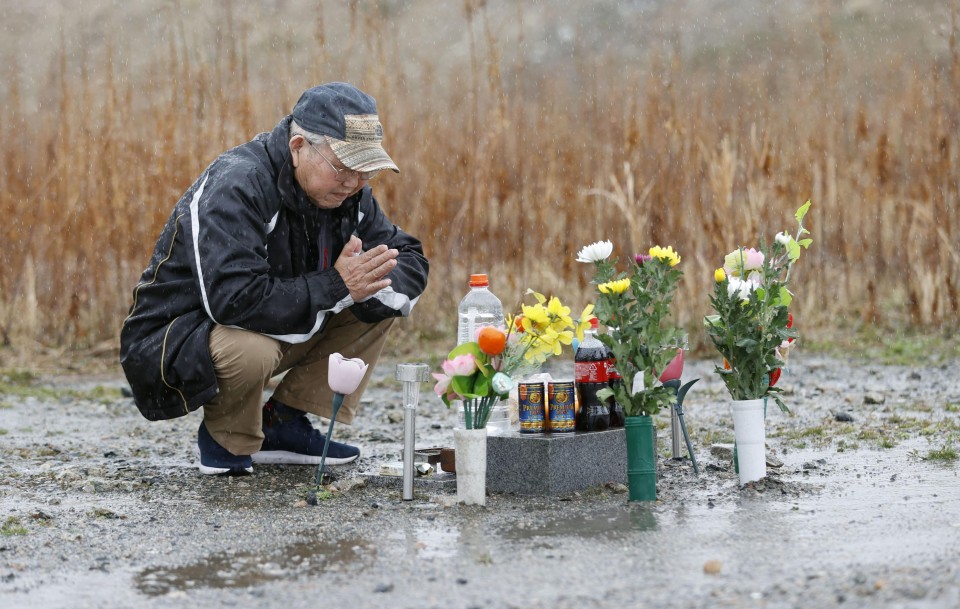 (Kazuo Sato puts his hands together in Namie, Fukushima Prefecture at a former post office site where his eldest son went missing in tsunami nine years ago)
Many have also chosen not to return, with the population of 90 percent of the 42 disaster-hit municipalities declining compared to what they were previously.
As of March 1, the disasters had left 15,899 people dead and 2,529 unaccounted for, mostly in the prefectures of Fukushima, Iwate, and Miyagi, according to the National Police Agency.
Nearly a quarter of those who died of illness or stress linked to the disasters in the three prefectures were people with disabilities, a recent Kyodo News survey showed.
Another survey by Kyodo found that at least 242 residents of public housing in the three prefectures had died alone, revealing the need for developing networks to support elderly residents and prevent them from isolating themselves.
Those aged 65 or older are living alone in about 30 percent of households in the public housing.
Last week the government approved a bill that will extend the life of the Reconstruction Agency, established to oversee rebuilding efforts, until 2031 — a decade longer than initially planned.
But doubts have been cast on whether Japan can stick to its time frame for dismantling the crippled nuclear power plant, operated by Tokyo Electric Power Company Holdings Inc.
Japan decided in December to delay the removal of spent fuel from the plant’s Nos. 1 and 2 reactors by as much as five years to March 2029.
CR:KYODO NEWS
 apecthai.com